
What to see
Labuan’s landmarks include a Commonwealth war cemetery, the Japanese surrender site, a 106-foot brick chimney of unknown purpose and a ship-shaped marine museum.
The Second World War sites
Three of Labuan’s most visited landmarks relate to the end of the Second World War in Borneo, and are close enough together to see in one afternoon: Labuan War Cemetery, Peace Park, and Surrender Point, which is next to the park.
The Chimney
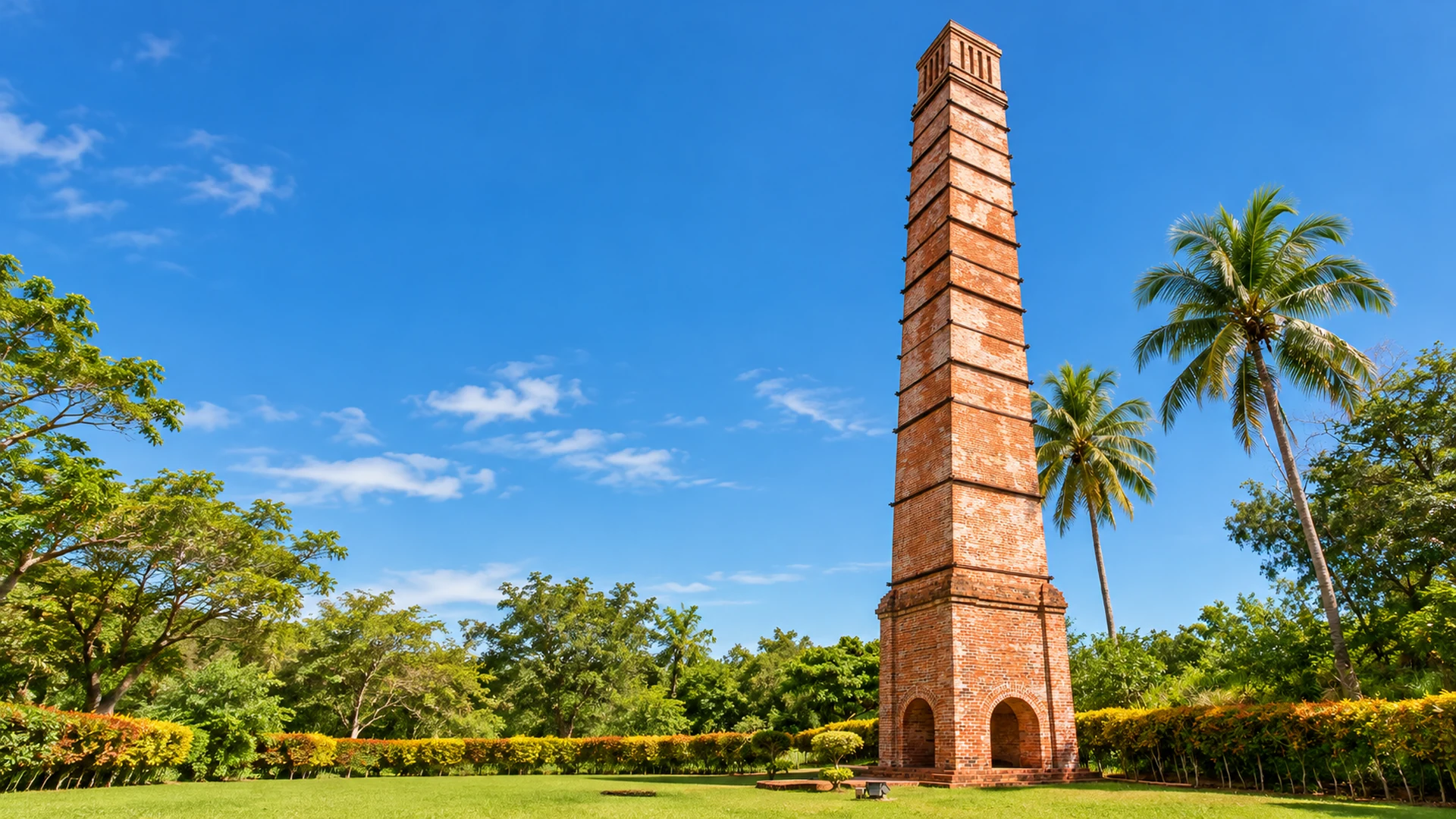
The Chimney stands 106 feet high at Tanjung Kubong and was built from thousands of red bricks imported from England. It was long assumed to be a ventilation stack for the nearby coal workings, but no traces of smoke have been found inside it, so its original purpose is still unknown.
Museums
Labuan Museum occupies a post-war colonial-style building on the waterfront, and the Labuan Marine Museum is built in the shape of a ship.
Source: Tourism Malaysia, Labuan Map & Guide (updated December 2023).
Labuan Botanical Garden
A hibiscus garden and a herb garden about 2 km from the town centre, created by Sir Hugh Low and laid out in the grounds of the old Government House known locally as Bumbung 12.
The garden
The park is on Jalan OKK Abdullah, about 2 km from the town centre, and consists of a hibiscus garden and a herb garden. Sir Hugh Low, then the British Chief Secretary of Labuan, is credited with creating it.
What is there now
The garden is landscaped with a range of tropical plants and mature trees, and includes a man-made lake and an arched bridge. It stands in the grounds of an old Government House known locally as Bumbung 12.
Source: Tourism Malaysia, Labuan Map & Guide (updated December 2023).
| Location | Jalan OKK Abdullah, about 2 km from the town centre |
|---|---|
| Gardens | Hibiscus garden and herb garden |
| Created by | Sir Hugh Low |
| Site | Grounds of the old Government House (“Bumbung 12”) |
Labuan Clock Tower
A landmark in Labuan town centre, within the walkable area that also holds the museum, the waterfront, Financial Park and the ferry terminal.
Where it is
The clock tower stands in Labuan town centre. The centre is compact and one of the most pedestrian-friendly in Malaysia, so it sits within easy walking distance of Labuan Museum, the waterfront, Financial Park and the international ferry terminal.
Seeing it
It is an open street landmark rather than a site you enter, so there is no ticket and no opening time. Most visitors pass it while walking between the museum and the shopping area rather than making a separate trip.
Source: Town centre walkability from Tourism Malaysia, Labuan Map & Guide (updated December 2023).
The construction date and history of the tower could not be verified from a source we could name, so they are not stated here.
| Type | Street landmark |
|---|---|
| Location | Labuan town centre |
| Entry | Free, viewable from the street |
Financial Park Labuan
Financial Park is the centre of Labuan’s offshore financial industry and also holds the island’s largest shopping complex.
Two things in one place
Financial Park reflects both sides of Labuan. The island was declared an International Offshore Financial Centre in 1990, and this is where that industry sits. The same development houses the most popular shopping complex on the island, which is what brings visitors through the doors.
What visitors use it for
The mall draws both tourists and residents for its range of duty-free goods, and has several restaurants, ATMs and a post office. For a short trip that combination is genuinely useful: it is the one place that covers shopping, cash and postage in a single stop.
Source: IOFC designation and mall facilities from Tourism Malaysia, Labuan Map & Guide (updated December 2023).
Getting there
It is in the town centre and walkable from most town hotels and the ferry terminal.
| Also known as | Ujana Kewangan |
|---|---|
| Contains | Offices, shopping complex, restaurants, ATMs, post office |
| Context | Labuan was declared an IOFC in 1990 |
| Access | Walkable from the town centre |
Labuan Marine Museum
Built in the shape of a ship, the Labuan Marine Museum holds 572 collections of marine specimens and related items, including fishing tools, diving equipment and oceanography technology.
The collection
The museum holds 572 collections made up of marine specimens together with items such as fishing tools, diving equipment and oceanography technology.
Location and building
The building is shaped like a ship and forms part of the Labuan International Sea Sports Complex. There is an interactive section where visitors can touch marine life.
Source: Tourism Malaysia, Labuan Map & Guide (updated December 2023).
| Collections | 572 |
|---|---|
| Building | Shaped like a ship |
| Part of | Labuan International Sea Sports Complex |
| Telephone | 087 425 927 |
Labuan Museum
Labuan Museum is housed in a post-war colonial-style building on the waterfront. Its displays run from the prehistoric era through the Brunei Sultanate, British colonial rule, Independence and Federal Territory status.
The building
The museum occupies a post-war colonial-style building on the waterfront. History Square overlooks it.
The displays
The exhibits cover the prehistoric era, the Brunei Sultanate, the British colonial period, the declaration of Independence, and the establishment of Labuan as a Federal Territory. There are also displays on the main communities living in Labuan and their cultures and traditions.
Source: Tourism Malaysia, Labuan Map & Guide (updated December 2023).
| Building | Post-war colonial style, on the waterfront |
|---|---|
| Nearby | History Square |
| Telephone | 087 414 135 |
| Hours | Confirm current opening hours before visiting |
Labuan War Cemetery: Malaysia’s Largest War Memorial
The largest war memorial in Malaysia and the burial place of 3,908 war dead from Australia, Britain, New Zealand and Malaya.
What it is
Labuan War Memorial is the largest memorial of its kind in Malaysia. It is the burial place of 3,908 war dead from Australia, Britain, New Zealand and Malaya, which is now Malaysia.
Remembrance Day
A Remembrance Day ceremony is held here each year in full military tradition, in memory of those buried at the cemetery. It takes place on 11 November, or on the Sunday closest to that date, and honours the soldiers who died during the Second World War.
Visiting
This is an active war cemetery rather than a monument. Dress appropriately, keep noise to a minimum, and stay on the paths between the rows of graves.
Source: Tourism Malaysia, Labuan Map & Guide (updated December 2023).
| Burials | 3,908 |
|---|---|
| Nations | Australia, Britain, New Zealand, Malaya |
| Status | Largest war memorial in Malaysia |
| Ceremony | Remembrance Day, 11 November or the nearest Sunday |
Lubang Gantang Coal Mining Shaft
A coal mining shaft from the colonial working at Tanjung Kubong, in the north of the island.
What it is
Lubang Gantang is one of the shafts left by the coal industry that operated in northern Labuan during the British colonial period. It belongs to the same group of sites as the Tanjung Kubong tunnel and the Chimney.
Visiting
It is in the northern part of the island and needs a car or taxi from town. Most visitors see it as part of a run that also takes in the Chimney and Labuan Bird Park, which are in the same direction.
Access arrangements and safe entry could not be verified from a current source, so they are not published here. Treat any historic mine shaft as unsafe unless it is an open, maintained visitor site with clear signage.
Source: Coal working context from Tourism Malaysia, Labuan Map & Guide (updated December 2023).
| Type | Coal mining shaft |
|---|---|
| Location | Tanjung Kubong area, northern Labuan |
| Combine with | The Chimney and Labuan Bird Park |
Peace Park (Taman Damai)
A landscaped memorial built as a statement against war. It has a raised mound with two arched walls, gazebos, and Japanese-style bridges and ponds. It is the only park of its kind in Malaysia.
What it commemorates
Peace Park is set in a landscaped area and serves as both a memorial and a statement against war. A bronze plaque at the entrance commemorates the surrender that took place next door at Surrender Point.
The design
The park contains a large raised mound with two arched walls, gazebos, and Japanese-style bridges and ponds. Labuan Peace Park is the only park of its kind in the country, built to represent peace and harmony.
Source: Tourism Malaysia, Labuan Map & Guide (updated December 2023).
| Also known as | Taman Damai |
|---|---|
| Features | Raised mound, two arched walls, gazebos, bridges and ponds |
| Adjacent | Surrender Point |
| Notable | The only park of its kind in Malaysia |
Surrender Point
The site where the 37th Japanese Southern Army surrendered to the 9th Division of the Australian Imperial Force, marking the end of the Second World War in Borneo.
What happened here
Surrender Point is next to Peace Park. It marks the place where the 37th Japanese Southern Army surrendered to the 9th Division of the Australian Imperial Force on 10 September 1945, which ended the Second World War in Borneo.
The site today
Surrender Point looks out over the South China Sea. It is usually visited together with Peace Park next door, and combines well with Layang-Layangan beach for sunset.
Source: Tourism Malaysia, Labuan Map & Guide (updated December 2023).
| Date | 10 September 1945 |
|---|---|
| Event | Surrender of the 37th Japanese Southern Army |
| To | 9th Division, Australian Imperial Force |
| Adjacent | Peace Park |
Tanjung Kubong Tunnel and Coal Shaft
A tunnel and coal shaft at Tanjung Kubong, left from the British-era coal workings that also produced the Chimney.
What it is
The tunnel and shaft at Tanjung Kubong are remains of the coal working that ran here during the British colonial period. They sit in the same part of northern Labuan as the Chimney, which is the best-known survival from the same industry.
Visiting
The site is at the northern end of the island, the same direction as Labuan Bird Park, around 16 km from the town centre. You will need a car or taxi.
Opening arrangements, lighting and whether the tunnel itself can be entered are not published here because they could not be verified from a current source. Check locally before making the trip, and do not enter an unlit or unmaintained shaft.
Source: Coal working context and northern-tip distance from Tourism Malaysia, Labuan Map & Guide (updated December 2023).
| Location | Tanjung Kubong, northern Labuan |
|---|---|
| Origin | British-era coal workings |
| Nearby | The Chimney, Labuan Bird Park |
| Access | Car or taxi. Confirm opening arrangements locally. |
The Chimney: Labuan’s 106-Foot Brick Tower
A 106-foot tower built from thousands of red bricks imported from England. No traces of smoke have ever been found inside it, and its original purpose has never been established.
The structure
The Chimney is one of Labuan’s best-known landmarks. The 106-foot structure was built from thousands of red bricks imported from England. An estimated 23,000 bricks were used to restore its outer walls.
Why its purpose is unknown
It was originally believed to be a ventilation stack for the coal workings at Tanjung Kubong. In recent years, however, no traces of smoke have been found inside the structure, so both its purpose and the reason it was built remain unexplained.
Visiting
The Chimney stands within the Chimney Historical Complex. It won a Green Apple Award in 2013 in the Archaeological Heritage category, which led to Labuan being named Green World Ambassador in 2014.
Source: Tourism Malaysia, Labuan Map & Guide (updated December 2023).
| Height | 106 feet |
|---|---|
| Material | Red brick imported from England |
| Restoration | About 23,000 bricks in the outer walls |
| Location | Chimney Historical Complex, Tanjung Kubong |
| Award | Green Apple Award 2013, Archaeological Heritage |
| Telephone | 087 463 603 |