
Four periods
Brunei Sultanate, British coal colony, Second World War battleground, Federal Territory. Labuan has changed hands and changed purpose more often than almost anywhere else in Malaysia.
At a glance
| Sultanate | Before the British period |
|---|---|
| Coal | Worked at Tanjung Kubong |
| Surrender | 10 September 1945 |
| War graves | 3,908 |
| Federal Territory | 16 April 1984 |
| IOFC | Declared 1990 |
The sequence
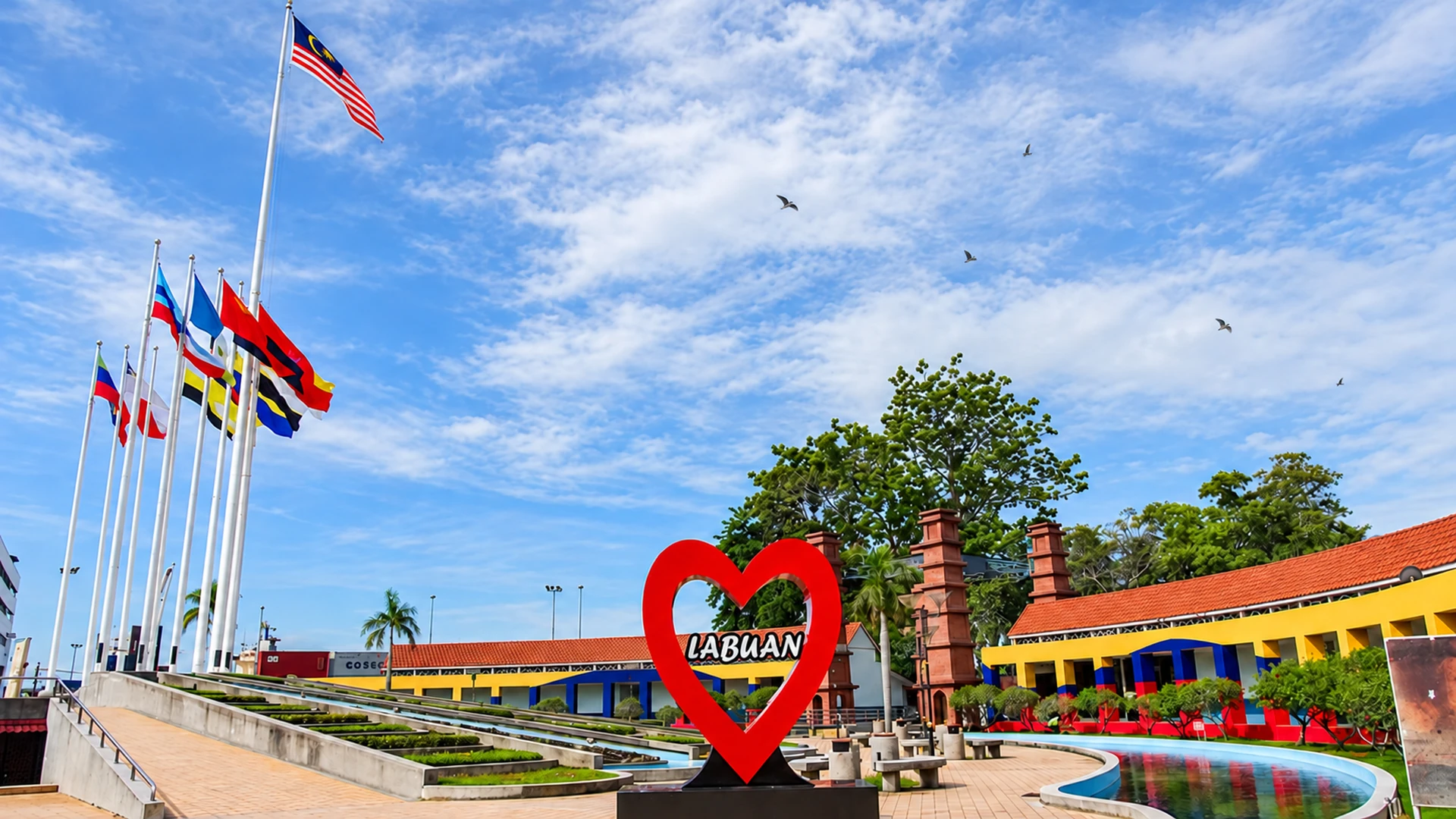
The displays at Labuan Museum lay the history out in order: the prehistoric era, the Brunei Sultanate, the British colonial days, the declaration of Independence, and the establishment of Labuan as a Federal Territory. History Square overlooks the museum.
Under the Brunei Sultanate
Before the British period Labuan was part of the Brunei Sultanate. That connection did not disappear with the change of flag. The residents of the water villages descend from fisherfolk, sailors and traders from neighbouring Brunei who settled here many generations ago, and Brunei-Malay food, including ambuyat and three of the island’s four local sweets, is still made here.
The British period
The colonial era brought coal working at Tanjung Kubong in the north. Its most visible survival is the Chimney: 106 feet built from thousands of red bricks imported from England, long assumed to be a ventilation stack for the coal workings, though no traces of smoke have ever been found inside it. Labuan Botanical Garden, credited to Sir Hugh Low, dates from the same period.
The Second World War
The Borneo campaign ended on Labuan. On 10 September 1945 the 37th Japanese Southern Army surrendered to the 9th Division of the Australian Imperial Force at what is now Surrender Point. Labuan War Cemetery, the largest war memorial in Malaysia, holds 3,908 war dead from Australia, Britain, New Zealand and Malaya. Peace Park was built next to the surrender site as a memorial and a statement against war.
Federal Territory
Labuan was established as a Federal Territory on 16 April 1984, making it one of three in Malaysia. It was declared an International Offshore Financial Centre in 1990, which is why Financial Park sits at the centre of the town today.
Source: All dates, figures and site descriptions from Tourism Malaysia, Labuan Map & Guide (updated December 2023).
Seeing it in order
The history itinerary visits these sites in the sequence above, which makes each one explain the next.